Do I Need a 3D Model Before Getting Something 3D Printed?
Have an idea but no printable file? Learn when you need a 3D model, what references to prepare and how design and production are quoted separately.
MAKE
10/2/20264 min read

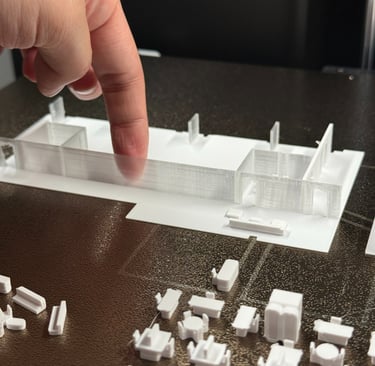
A physical architectural model with separate miniature components. The photograph shows a manufactured outcome, not a digital model or a before-and-after comparison.
You need a suitable digital model before an object can be 3D printed, but you do not need to arrive with one already finished.
You might have a sketch, photographs, a physical reference or a clear description of what you want to make. These can start a design enquiry. The important distinction is between information that explains an idea and a model that defines an object for production.
At LILIS LAB, developing that model and manufacturing the physical piece are separate commercial stages. Understanding the distinction makes it easier to plan the work and request the right help.
What does a printable model actually mean?
A printable model needs to describe the intended physical geometry at the correct scale. A visually convincing shape is not enough if its surfaces do not define a usable volume or its details cannot be produced in the chosen material and process.
Problems can include gaps in the surface, conflicting internal geometry, walls that are too thin or parts that intersect unintentionally. A model may need repair or redesign rather than simply a different export setting. Exact design limits depend on the manufacturing route; a wall-thickness recommendation tested on one printer and resin is not a rule for all printing.
It is useful to think of printability as a relationship between the model and its proposed use. A delicate display model and an object that will be handled frequently may need different design decisions even when they look similar.
What sketches and photographs can provide
A sketch can explain a silhouette, proportion or intended arrangement. Photographs can communicate surface character, details and the appearance of an existing object. Dimensions establish scale and help distinguish essential features from visual references.
A single photograph does not reveal every surface or internal dimension. If you need a specific object reconstructed, provide multiple views and measurements where possible. If accuracy depends on hidden features, explain those rather than expecting them to be inferred from an image.
References also need a clear purpose. Are they showing the exact form to reproduce, a texture you like or a general direction? Identifying that purpose helps avoid developing the wrong part of the idea. Only share designs and files you have permission to use for the proposed work.
STL, OBJ, STEP and 3MF in plain English
You may encounter several file types. They are not simply different names for an identical package of information.
STL describes a surface using triangles and is widely used for printing. OBJ is another model format that can carry additional information, although what a particular production tool imports may be more limited. STEP is commonly used to exchange CAD geometry; some slicing tools convert it to a mesh during import. 3MF can package a model together with additional project information. The data retained and accepted depends on the software.
None of these extensions certifies that a model is ready to manufacture. If you have the original design file as well as an exported mesh, mention both in your enquiry. Always state the intended dimensions separately so scale can be checked.
You do not need to convert everything before contacting us. Tell us what you have, and the appropriate file requirements can be confirmed for the project.
An existing model may need a different kind of help
If you already have a model, explain whether you want it printed as supplied, resized, repaired or redesigned. These are different tasks.
A downloaded model may suit a visual demonstration but not the exact size, finish or function you need. A file designed for one purpose can require further development when the intended outcome changes. Check the licence as well as the geometry before commissioning production.
For a new model, the brief is broader. LILIS LAB's design services include creative modelling, technical and parametric design, and reconstruction or file preparation. The appropriate route depends on the information available and the result you need.
What affects modelling complexity?
Complexity is not only about the size of the object or how many details it appears to have. It also depends on how precisely the design must be defined and how much remains unresolved.
A free-form sculpture may require careful work on its silhouette and surface transitions. A visually simple component may have demanding connection dimensions. An assembly needs decisions about how separate pieces fit and how they will be put together.
To make the brief clearer, identify which dimensions must remain fixed, what can be adjusted and what the model is intended to demonstrate. Explain whether the priority is appearance, fit, movement or a combination. If you are uncertain, state that uncertainty rather than supplying a measurement that has not been checked.
How the design and production stages work
The sequence at LILIS LAB is:
You submit references and requirements.
We review the modelling work and provide a separate 3D Design quotation.
You approve and pay for the agreed design stage.
The model is developed and submitted for your review.
You review and approve the final model.
The approved model is assessed for physical production.
A separate, accurate production quotation is provided.
An early conversation can establish your intended outcome and budget, but it is not an accurate final production quotation for an object that has not yet been fully defined. Final geometry and the agreed production requirements are needed for that assessment.
Design approval and authorisation to manufacture are also distinct decisions. If you want to proceed from a model to a physical object, confirm that next stage and its scope rather than assuming it is included in the design fee.
What to prepare before getting in touch
Bring together the references or files you already have, the intended dimensions and a short explanation of the object's purpose. Tell us the quantity, deadline and desired appearance, and flag any parts that need to fit, move or connect to something else.
If you have a budget, distinguish the overall project budget from any amount already allocated to design. If you do not know the material or process, that is fine. A clear account of how the object should be used is a better starting point than guessing technical settings.
You do not have to solve the manufacturing questions before asking them. The aim of the first enquiry is to understand what exists, what still needs developing and which stage of work should come next.
DON'T HAVE A 3D MODEL YET?
Share your references and tell us what you want to create.
EXPLORE 3D DESIGN
START A PROJECT

Lunae Group Ltd trading name: Lilis Lab
Studio by appointment only
Monday to Friday
09:00 am – 6:00 pm
Stratford, London E15 2SP
Upload files & order online 24/7
Address:
our service
3D design & development
on-demand 3D printing
post production & finishing
photography & visual production
artist platform
Contact Us
Email: info@lilislab.co.uk
Whatsapp/Phone:+44 7462 549660
WeChat: lilislab
© 2026 Lunae Group Ltd // Registration: 16961587